Charcoaling has a rich history in Slovenia that goes back thousands of years. In prehistoric times, charcoal production made it possible to extract metals such as copper, bronze and iron. Already in the Bronze Age (around 4000 to 3000 BC) Baker played a key role, while iron became important in the Iron Age (1200 to 500 BC), when the Celts and Others people developed advanced metalworking techniques. There were important smelter centers on our soil, as for example at Vače pri Litija, where they found famous ritual vessels – situlas.
History of charcoal making
In the Middle Ages and the Renaissance, coal mining remained the key to mining and iron industry. Without extensive forests and charcoal production, these industries would not have developed. With the arrival of coal, coal lost its primacy in metallurgy, but it was still preserved in smelting until the end of the 19th century.
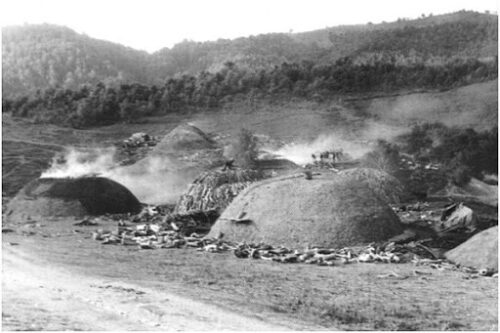
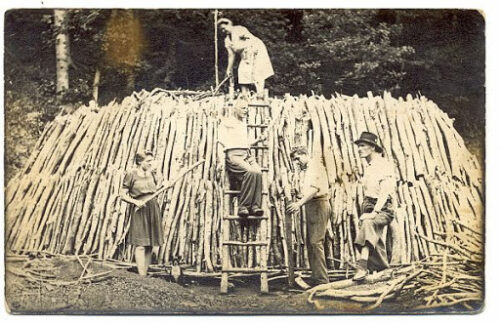
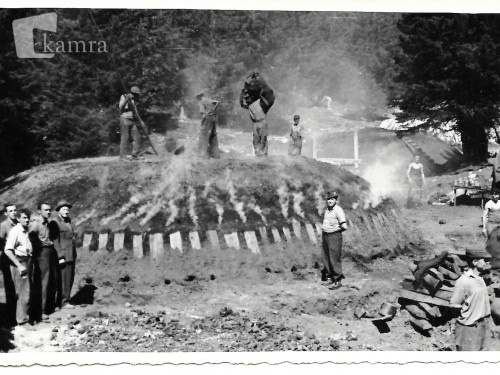
Oglaring experienced its greatest boom in the 19th century, especially around 1848 in Gorenjska, in Kočevské Rog and other parts of Slovenia. With the development of more modern methods of iron and transport, coal mining has decreased. By 1930, the annual production of charcoal, which was mainly intended for export, fell to 28-30 thousand tons annually. After the Second World War, coal mining remained present in Dolenjsko and some other areas, where it has been preserved to this day as a specialty.
Oglar’s heritage is still visible all over Slovenia, from the Škofjeloški hills to Pohorje and Trnovsko gozd. The remains of the mounds are scattered in the forests, which testifies to the rich tradition of charcoal making in our country, which has shaped our country throughout history. Today, around 50 charcoal burners in Slovenia put up about 100 traditional coal mines every year. Every year, various events take place across the country, which show this important heritage, which is also entered in the Register of Intangible Cultural Heritage, and in the Oglarska dežela near Litija, a year-long high-quality coal tourist offer is developed, and only here can you become A real charcoal burner for a day.
Interesting facts:
- Charcoal was also important in Egyptian culture, as it was used to embalm the bodies of important people.
- Charcoal was also used in art, as artists drew and created the first sketches with it.
- Charcoal was so valued that it was sometimes used as a means of payment.
- Charcoaling was a solitary craft, as the coal miners lived in the forest for weeks or even months while they made charcoal.
- In the 19th century, charcoal was called “black gold”, which is still used today, as it was extremely valuable and powered the economy of many countries.
If you are interested in more about the history of coal mining in Slovenia, visit the website Association of Oglars of Slovenia.